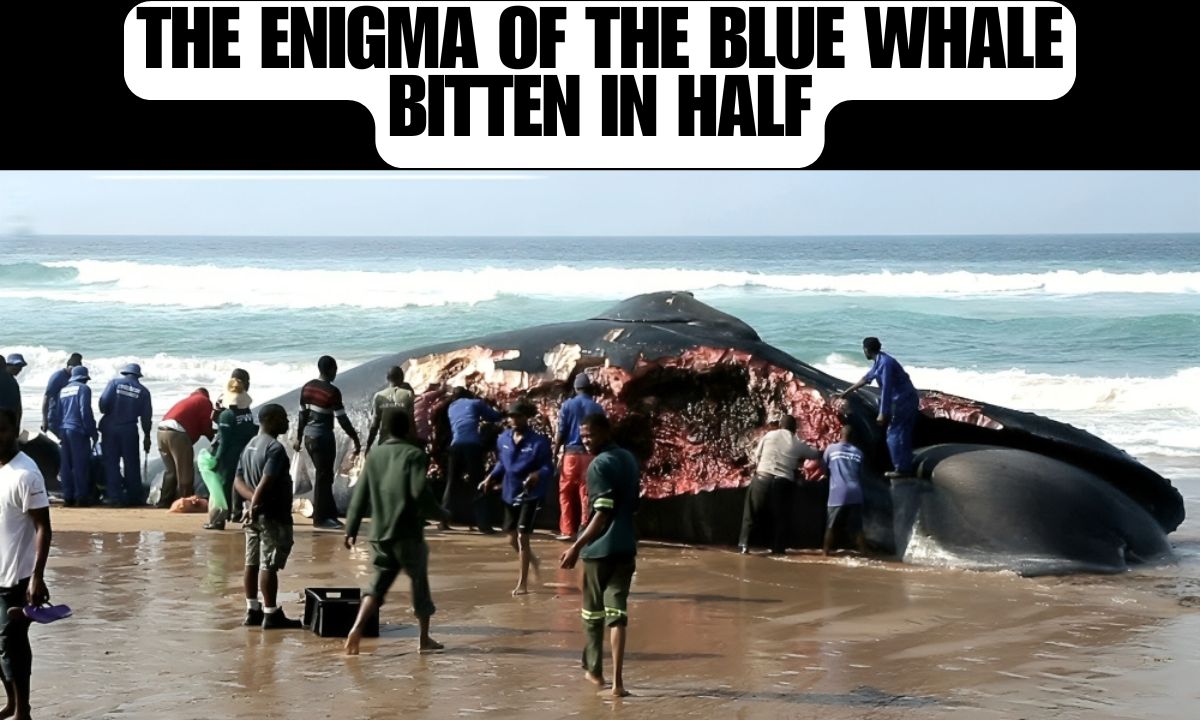
In the vast expanse of our world’s oceans, few discoveries have captured the imagination and concern of marine biologists quite like the shocking find of a blue whale bitten in half. This extraordinary case has left researchers grappling with questions about the ocean’s deepest secrets and the hidden dynamics of marine predator behavior.
What makes this discovery particularly intriguing is its challenge to our understanding of marine apex predator capabilities and the delicate balance of power in our oceans. The incident has sparked renewed interest in deep-sea research and marine mammal protection efforts worldwide.
A Shocking Discovery
The maritime community was stunned when local authorities off the South African coast encountered what appeared to be the remains of the world’s largest marine mammal – a blue whale – mysteriously severed in what appeared to be a single, catastrophic encounter. The massive body of this oceanic giant, measuring approximately 89 feet in length, bore evidence of what would become one of the most puzzling marine mysteries of our time.
“In my 30 years studying marine mammals, I’ve never encountered anything quite like this,” notes Dr. Sarah Martinez, lead marine biologist at the Ocean Research Institute. “The clean nature of the separation suggests an apex predator of extraordinary size and power.”
Adding to the mystery, local fishing vessels reported unusual predator activity in the area during the weeks leading up to the discovery. Satellite tracking data revealed unprecedented gathering patterns of large marine predators, suggesting this tragic event might have been preceded by broader ecological changes in the region.
The Evidence Unveiled
The investigation into this marine tragedy revealed several crucial pieces of evidence that helped piece together this oceanic tale. Marine biologists discovered distinctive patterns in the bite marks that would become central to understanding this unprecedented event.
Key Findings:
- Bite radius measuring approximately 7.8 meters
- Distinct serration patterns consistent with large predatory species
- Tissue analysis suggesting a single, powerful bite rather than multiple attacks
- Depth-related pressure marks indicating the attack occurred at approximately 500 meters
Advanced sonar mapping of the surrounding ocean floor revealed unusual topographical features that might have created the perfect hunting ground for large predators. This discovery suggests that certain ocean zones might serve as natural ambush points for apex predators, challenging our previous understanding of marine hunting behaviors.
The Culprit: A Shark’s Mark
Analysis of the bite marks pointed strongly toward a massive great white shark, though the size implications have left many experts skeptical. Here’s what we know about great white shark bite force and capabilities:
| Predator Type | Average Bite Force (PSI) | Max Recorded Size (ft) |
| Great White | 4,000 | 20 |
| Killer Whale | 19,000 | 32 |
| Ancient Megalodon | 40,000 | 59 |
Recent advances in marine forensics have allowed scientists to create 3D models of the bite pattern, revealing previously unnoticed details about the attack angle and force distribution. These findings suggest the possibility of an unusually large specimen or perhaps even an unknown species of shark.
Stats and Speculation
The blue whale’s fate in the ocean has sparked intense debate among marine researchers. Here are some critical statistics about blue whales:
- Average Length: 80-100 feet
- Average Weight: 200,000-300,000 pounds
- Swimming Speed: Up to 20 mph
- Diving Depth: Up to 1,640 feet
Furthermore, new satellite tracking data has revealed previously unknown blue whale behavioral patterns, suggesting these magnificent creatures might be more vulnerable to predation during certain phases of their migration than previously thought.
A Question Lingers
The ocean guards its mysteries well, and this case continues to perplex marine scientists worldwide. Several theories have emerged:
- Multiple Predator Theory
- Possibility of coordinated attack
- Evidence of various bite marks
- Social hunting behavior observed in other species
- Environmental Factors
- Unusual migration patterns
- Changes in ocean temperature
- Shifting prey distribution
Recent deep-sea exploration has uncovered evidence of similar incidents throughout history, preserved in sediment layers and fossil records. These findings suggest such predator-prey interactions, while rare, might have been occurring for millions of years.
Conclusion
The enigma of the blue whale bitten in half remains one of the most fascinating marine mysteries of our time. While great white shark bite patterns offer the most compelling explanation, the sheer scale of the incident continues to challenge our understanding of ocean predator capabilities.
This case has catalyzed a new wave of marine research, leading to groundbreaking discoveries about predator behavior and ocean ecosystem dynamics. It serves as a humbling reminder that our oceans still hold countless secrets waiting to be unveiled.
“This case reminds us that the ocean still holds many secrets, and we must approach these mysteries with both scientific rigor and an open mind.” – Dr. James Thompson, Marine Predator Specialist
Resources for Further Research:
- Marine Mammal Research Database
- International Whale Conservation Society
- Ocean Predator Tracking Program
- Global Marine Incident Reports
This extraordinary event continues to drive research into marine predator behavior and reminds us that even in our modern age, the ocean’s deepest secrets can still surprise and mystify us.
