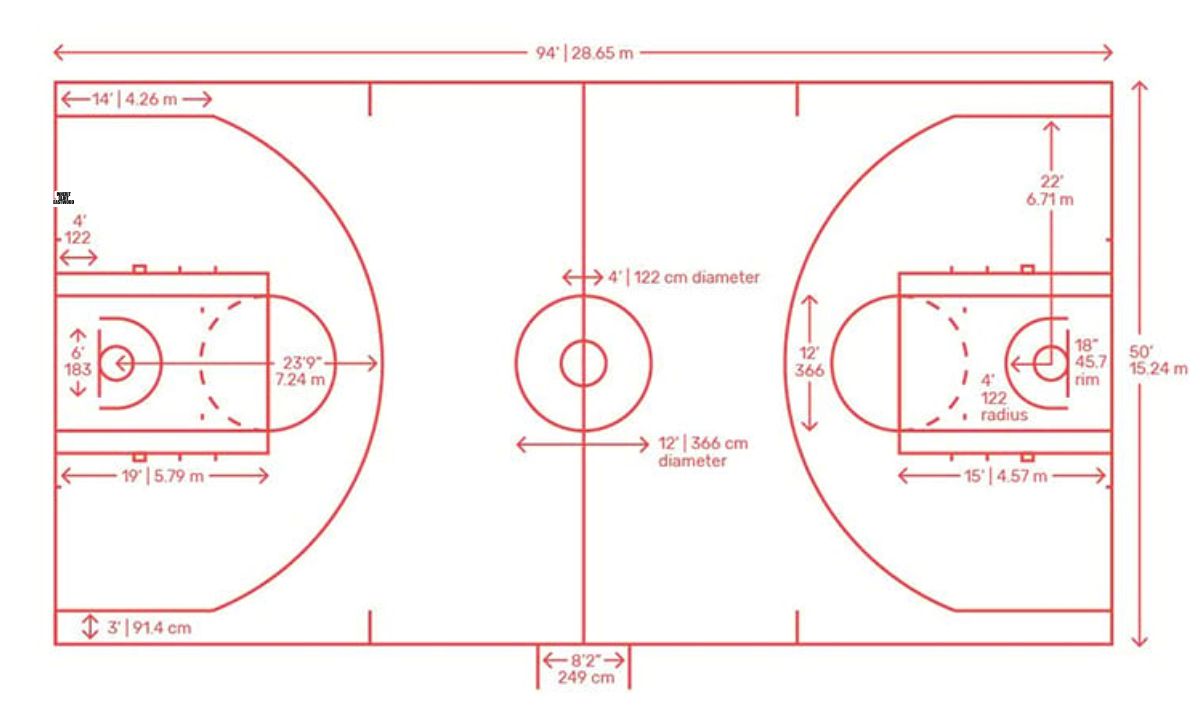
When planning to build a basketball court, whether it’s for a school gymnasium, community center, or professional arena, understanding the precise dimensions and specifications is crucial.
Let’s dive into everything you need to know about basketball court dimensions and installation requirements.
What Are the Parts of a Basketball Court?
A basketball court is more than just a rectangular playing surface. It’s a carefully designed space where every line, arc, and zone serves a specific purpose. Let’s break down each essential component:
Lane
The lane, often called “the paint,” is one of the most crucial areas on a basketball court.
Standard Lane Dimensions:
- Width: 16 feet (NBA/NCAA)
- Length: 19 feet
- Free throw line distance: 15 feet from backboard
Fun fact: The lane is wider in the NBA (16 feet) compared to international courts (12 feet) to accommodate the more physical style of play.
Three-Point Arc
The three-point line has revolutionized basketball strategy. Here are the current specifications:
| Level of Play | Distance from Basket (Center) | Arc Radius |
| NBA | 23’9″ | 22′ |
| NCAA | 22’1.75″ | 20’9″ |
| High School | 19’9″ | 19’9″ |
Sidelines and Baselines
These boundary lines define the court’s perimeter:
- Sideline length (NBA/NCAA): 94 feet
- Baseline width: 50 feet
- Minimum out-of-bounds clearance: 3 feet (recommended: 10 feet)
Center Circle
The center circle hosts the opening tip-off:
- Diameter: 12 feet
- Center line width: 2 inches
- Jump ball circle diameter: 6 feet
Key Area
The key area includes several important markings:
- Restricted area arc: 4-foot radius
- Free throw lane: 19 feet long
- No-charge semicircle: 4 feet (NBA only)
Division Line
The division line splits the court equally:
- Located 47 feet from each baseline
- Width: 2 inches
- Must contrast with court color
Different Basketball Court Sizes
Basketball courts come in various sizes to accommodate different levels of play. NBA and NCAA courts measure 94′ x 50′, while high school courts are typically 84′ x 50′.
Middle schools often use 74′ x 42′ courts, and elementary schools may go even smaller at 60′ x 35′. For recreational use, half-courts and 3v3 courts offer flexible options for limited spaces, with dimensions as small as 30′ x 30′ for practice areas.
1. Full-sized basketball court for College, NCAA, NBA, and Olympics
Professional Court Specifications:
- Length: 94 feet
- Width: 50 feet
- Total square footage: 4,700 sq ft
- Minimum ceiling height: 23 feet
“Professional basketball courts require precise measurements and high-quality materials to ensure optimal player performance and safety.” – John Smith, NBA Court Designer
2. High School basketball court dimensions
High school courts typically follow these measurements:
- Length: 84 feet
- Width: 50 feet
- Total square footage: 4,200 sq ft
- Minimum ceiling height: 20 feet
3. Junior High School and Middle School Basketball Court Dimensions
These courts are designed specifically for younger players:
- Length: 74-84 feet
- Width: 42-50 feet
- Three-point line: 19’9″
- Free throw line: 15 feet
Key Design Features:
- Adjustable rim heights (8.5-10 feet)
- Reduced court size for better player development
- Modified lane width: 12 feet
- Smaller key area for age-appropriate play
Elementary School Basketball Court Dimensions
Elementary courts prioritize learning and skill development:
- Length: 60-74 feet
- Width: 35-42 feet
- Free throw line: 13-15 feet
- Lower rim height options (8-9 feet)
Safety Considerations:
- Padded walls and support posts
- Extra wide out-of-bounds areas
- Non-slip surface treatments
- Clear sightlines for supervision
Dimensions for Small Basketball Courts
Perfect for recreational facilities and community centers:
| Court Type | Length | Width | Key Features |
| Mini Court | 40-50 ft | 30-35 ft | Single basket |
| Practice Court | 50-60 ft | 35-40 ft | Shooting stations |
| Recreation Court | 60-70 ft | 35-45 ft | Multiple games |
Basketball Half-Court Dimensions
Popular for home and recreational use:
- Standard size: 47′ x 50′
- Minimum size: 30′ x 30′
- Free throw line: 15′ from backboard
- Three-point arc: Matches full court specifications
Benefits of Half-Court Design:
- Lower installation costs
- Reduced space requirements
- Perfect for practice sessions
- Ideal for 3v3 games
3 vs 3 Basketball Court Dimensions
FIBA-approved 3×3 specifications:
- Length: 49 feet
- Width: 36 feet
- Free throw line: 15 feet
- Three-point arc: 22 feet
- Single basket setup
25 x 25 Basketball Court Dimensions
Ideal for small spaces and residential installations:
- Total area: 625 square feet
- Reduced three-point line
- Modified key area
- Perfect for shooting practice
Space-Saving Features:
- Compact design
- Multi-purpose potential
- Minimal equipment requirements
- Efficient use of available space
Important Considerations
When installing a basketball court, several factors need careful attention. The foundation must be perfectly level and properly prepared for drainage. Surface material choices – whether hardwood, synthetic, or concrete – affect both performance and maintenance requirements.
Lighting should be uniform and glare-free. Safety features like proper line visibility and non-slip surfaces are essential. Local building codes and ADA compliance must be factored into the design.
Environmental Factors:
- Indoor vs. outdoor placement
- Climate considerations
- Drainage requirements
- Sun orientation
- Wind exposure
Technical Requirements:
- Foundation preparation
- Surface leveling
- Line marking methods
- Lighting placement
- Ventilation needs
Maintenance Planning:
- Regular cleaning schedule
- Surface refinishing
- Line repainting
- Equipment checks
- Safety inspections
“The key to a successful basketball court installation is thorough planning and attention to detail in every phase of the project.” – Mike Johnson, Professional Court Constructor
Interested in knowing the cost of your project?
Basketball court installation costs vary widely based on size, materials, and location. A basic outdoor concrete court might start around $25,000, while a professional-grade indoor court can exceed $100,000.
Key cost factors include surface materials ($3-8 per square foot), installation labor ($2.50-5 per square foot), and equipment like backboards and lighting ($5,000-20,000).
Additional expenses include site preparation, drainage systems, and ongoing maintenance. For accurate pricing, consult local contractors who can assess your specific needs.
Factor-Based Cost Analysis:
- Surface Material Costs
- Hardwood: $3.50-$6.00 per sq ft
- Synthetic: $2.50-$4.50 per sq ft
- Concrete: $2.00-$8.00 per sq ft
- Sports tiles: $4.00-$7.00 per sq ft
- Installation Labor
- Professional installation: $2.50-$5.00 per sq ft
- Site preparation: $1.50-$3.00 per sq ft
- Line marking: $500-$2,000 total
- Equipment and Accessories
- Backboards and rims: $1,000-$5,000 each
- Padding and safety features: $2,000-$8,000
- Lighting systems: $5,000-$15,000
Conclusion
Building a basketball court requires careful attention to dimensions, materials, and installation standards. Whether you’re planning a professional facility or a backyard court, success depends on proper planning and execution.
Key points to remember:
- Match court dimensions to your intended level of play
- Never compromise on safety features or material quality
- Work with certified contractors
- Consider maintenance requirements
- Follow local building codes
Remember that a well-designed court balances proper dimensions, quality materials, and expert installation. Starting with accurate measurements and understanding your specific needs will lead to better results and long-term satisfaction.
Ready to begin? Start by measuring your space and reaching out to qualified contractors who can turn these specifications into reality. With proper planning, your court will provide years of enjoyment and athletic development for players of all skill levels.
Basketball Court Design Q&A
Is there a minimum ceiling height requirement for basketball courts?
Yes. NBA courts require a minimum ceiling height of 23 feet. High school gyms need at least 20 feet clearance. For recreational facilities, 16 feet is the minimum, though higher is better for optimal play.
What are the minimum dimensions for a basketball court?
The smallest functional basketball court should be at least 30′ x 30′ for recreational play. However, regulation courts vary by level: NBA/NCAA (94′ x 50′), high school (84′ x 50′), and junior high (74′ x 42′).
How much space is needed for a basketball court?
Beyond the court’s playing dimensions, you need additional space for safety zones – ideally 3-10 feet of clearance on all sides. For a full-size court with proper clearance, plan for roughly 110′ x 65′ of total space.
What are the key design considerations for installing a basketball court on a school gymnasium floor?
- Proper subfloor preparation and moisture barriers
- Non-slip surfaces that can handle multiple sports
- Clear game lines that don’t create confusion
- Adequate lighting without glare
- Impact resistance for heavy use
- Acoustic considerations
- Built-in flexibility for different activities
